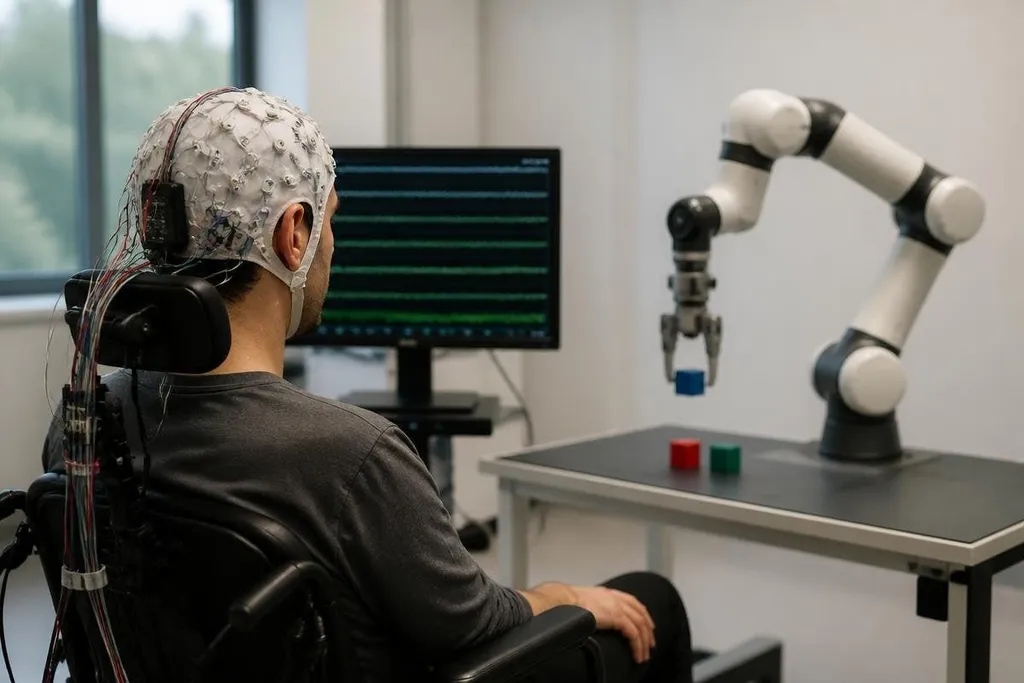
A brain-computer interface, or BCI, reads brain activity and turns it into commands for a computer. When that computer controls a robot, a person can guide a cursor, robotic arm, prosthetic hand, or exoskeleton without moving the control device by hand.
The rise of these systems matters because they could help people with severe movement limits control machines. The hard part is still clear: brain signals are weak, noisy, and different from one person to the next.
- Signal type matters: EEG reads activity through sensors on the scalp, while implants record signals closer to the brain.
- Robots add a second problem: the system must turn a person’s intent into safe movement around real objects.
- The open question: how well can a BCI work outside a lab, over long periods?
How a BCI controls a robot
Most BCI systems follow the same basic chain. Sensors collect brain activity, software picks out a pattern linked to an intended action, and a control system sends a command to the robot.
An EEG cap reads electrical activity through the scalp. It avoids surgery, but the signal has to pass through skin, bone, and tissue before the sensors record it. That makes the data less precise and can make control harder when the person moves.
Implanted electrodes record activity closer to the source. They can give the software a cleaner signal, though surgery, maintenance, and long-term safety become part of the design. The choice is not a simple race between two sensor types. It depends on the task, the medical need, and the level of control required.
A BCI also needs a decoder. This software links patterns in brain activity to commands such as move left, select, stop, or close the hand. A robotic arm may then combine those commands with cameras, force sensors, and position data so it can move without hitting nearby objects.
That shared control matters. Asking a person to guide every joint would create too much work. Letting the robot handle every decision would remove control from the person. A useful system divides the job in a way the person can understand and stop.
Where robotics adds value
A BCI can help with tasks that need more than a screen cursor. A robotic arm can reach, carry, and place an object. A prosthetic hand can open or close its fingers. An exoskeleton can assist leg movement while sensors and software track balance.
The robot does not read thoughts in the broad sense. It reads trained patterns linked to a known task. That difference matters when a product claim suggests a machine can understand any intention without practice.
Training can take time because the decoder must learn the person’s signal, while the person learns how to produce a usable pattern. Signal quality can also change with electrode position, fatigue, electrical noise, or movement.
A system that works during a seated session may need more work before it can handle a kitchen, workshop, or care setting.
A seated BCI demo may move a robot arm once, while daily use depends on repeatable signals and safe stops. BCI robotics reporting from Robot24.com can tie that claim to the named system, task, and measured result before the next section examines the limits.
The limits that decide whether it works
Safety comes before speed. A wrong command from a hand prosthesis may close the fingers at the wrong time. A wrong command from an exoskeleton could affect balance. Each system needs a clear stop action, limits on movement, and a way to reject uncertain commands.
Privacy also needs careful treatment. Brain data can reveal patterns linked to attention, fatigue, or intended movement. A system that stores those signals creates a record that needs strict access rules, especially when a hospital, employer, or device maker handles the data.
Cost and care add another barrier. An implanted BCI needs a medical procedure and follow-up support. An external system may be easier to fit, but it can need frequent setup and calibration. Neither approach removes the need for trained staff and regular checks.
I’d judge a BCI robot by how well it handles missed commands, not by the smoothest demo.
A practical check before buying or funding one
Use these questions when reviewing a BCI robotics project:
- Name the signal: Does the system use EEG, implanted electrodes, muscle signals, or several sensors together?
- Define the task: Can the person select, move, stop, and recover from an error?
- Check the setting: Has anyone tested it with noise, movement, fatigue, and nearby objects?
- Measure the delay: How long passes between the intended action and robot movement?
- Plan the stop: Can the person halt the robot without relying on the BCI?
- Count the care work: Who fits the sensors, checks the data, and fixes calibration problems?
BCIs and robots are becoming a closer technical match because each can cover a weakness in the other. The BCI can express intent, while the robot can handle motion, force, and position.
The next useful proof will be routine control over long sessions, with clear error rates and safety records. Until those figures are public for each system, a lab demo shows potential, not a finished product.